


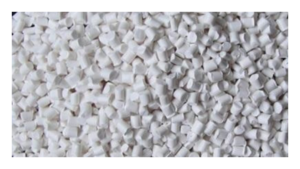
In the modern manufacturing world, tracing and identifying your products is key to controlling quality and ensuring the company remains compliant, and is vital to protecting the brand. Whether it be vehicle parts and electrical components or generic consumer goods or medical devices, ways of marking with permanency are being sought by manufacturers. Laser Marking Masterbatch offers an innovative solution that produces visually high-contrast permanent markings without the need for inks or labels, etc.
Laser marking masterbatches are formulated exclusively to use with laser-based marking systems; laser marking masterbatches can provide superior marking quality and higher productivity. Laser marking masterbatches can produce high-quality laser markers that have clear, precise, and durable marks.
WHAT IS LASER MARKING MASTERBATCH?
Laser Marking Masterbatch is a special additive concentrate added at a certain stage of plastics processing. It provides easily readable, high-contrast information directly on the surface of the plastic component after laser beam exposure.
Contrary to conventional marking processes, laser marking doesn't need any End-user consumables (Inks, solvents, self-adhesives).
This produces a permanent mark that enhances the aesthetic of the product and complements automated production processes.
Furthermore, we see that manufacturers on the various presented formulations call these Laser Engraving Additives, Laser Coding Masterbatch, or Laser Printable Compounds.
WHY LASER MARKING IS BECOMING THE PREFERRED CHOICE
Because of its speed, accuracy, and reliability, manufacturers from all industries prefer laser technology over conventional marking methods.
Some key benefits include:
Permanent product identification
High-speed marking process
Excellent marking consistency
Reduced operating costs
No inks or chemicals required
Improved production efficiency
Enhanced product aesthetics
These benefits make laser marking an excellent choice for today's industrial manufacturing.
KEY FEATURES OF LASER MARKING MASTERBATCH
A high-quality Laser Marking Masterbatch offers a variety of performance benefits that contribute to both enhanced processing and the quality of the finished articles.
High-Contrast Marking
Special formulations develop a distinctive crisp detail that is clearly defined even on dark colored plastics.
Permanent Identification
Because they are created using laser technology, the markings produced are resistant to scratching, chemicals, and dampness, unlike printing or ink.
Excellent Processing Compatibility
Laser markable masterbatches should be fully compatible with the other polymers used within the article of manufacture so that the laser mark is distributed uniformly throughout the article of manufacture.
Improved Manufacturing Efficiency
The absence of the secondary labeling/printing operation means both time savings in production and less maintenance.
LASER MARKING MASTERBATCH FOR PLASTIC COMPONENTS
A widely used application is Laser marking masterbatch for Plastic Components because it's crucial to identify the parts from production to quality control and regulatory requirements.
Typical applications include:
Automotive parts
Electrical connectors
Consumer electronics
Medical equipment
Household appliances
Industrial machinery components
Packaging products
The use of Laser Coding Masterbatch gives manufacturers the ability to permanently mark the plastic part without any structural impact.
INDUSTRIES THAT USE LASER MARKING MASTERBATCH
Laser marking technologies are used by many industries to mark products for identification and quality assurance purposes.
Automotive Industry
Permanent marking is used by vehicle manufacturers for code identification, original serial number, safety, and production tracking.
Medical Industry
There is a need for highly accurate product identification for medical devices.
Consumer Goods
Marking which include branding, logos, manufacture date, products information on plastic products can be achieved using laser marking.
Industrial Manufacturing
Industrial part identification often needs to be durable for inventory management, maintenance, and product life tracking.
BENEFITS OF CHOOSING QUALITY LASER MARKING MASTERBATCH
An experienced supplier guarantees a reliable quality of marking and a trustworthy production behavior.
Some key benefits include:
Uniform additive dispersion
Reliable laser response
Consistent batch quality
Enhanced marking clarity
Technical application support
Customized product formulations
Improved manufacturing productivity
All of these logically lead us to tasting as good finished products at a lower price.
PRODUCT TRACEABILITY THROUGH LASER MARKING
Product Traceability holds great value for most modern industries across manufacturing and the value chain because-
Laser marking helps manufacturers:
Track products throughout production
Improve inventory management
Simplify warranty verification
Support quality assurance programs
Enhance anti-counterfeiting measures
Meet regulatory documentation requirements
The permanent ID offers valuable information even in the most severe operating environments.
FACTORS TO CONSIDER WHEN SELECTING LASER MARKING MASTERBATCH
The best masterbatch selection depends on a number of criteria:
Polymer Compatibility
It is recommended that the formulation be suitable for the polymer to provide overall marking quality and processability.
Laser System Compatibility
Separately, some laser systems may demand particular compositions to achieve better marking contrast and quicker results.
Marking Requirements
Prior to a specific formulation being selected, manufacturers should evaluate the necessary contrast, speed of marking, robustness, and coding severity.
Processing Conditions
Temperature, mouldings, type of manufacturing processes, and time.
FUTURE TRENDS IN LASER MARKING TECHNOLOGY
As the world of advanced manufacturing progresses.
Emerging developments include:
Integration with Industry 4.0 systems
Advanced product authentication
Improved coding technology
Faster automated production lines
Enhanced traceability solutions
Sustainable labeling alternatives
The escalating demand for identification solutions coupled with automated manufacturing is accelerating the development of laser marking masterbatch.
ABOUT BLEND GROUP
For Blend Group, innovation is at our very core. We focus on manufacturing leading-edge masterbatch and polymer solutions for manufacturers who require improved performance, more efficient processing, and innovative material solutions that address dynamic industry needs.
CONCLUSION
Laser Marking Masterbatch is now an integral component for all manufacturers requiring precise, permanent, and inexpensive identification of their products. Whether through assisting with Product Traceability, providing High Contrast markings, or through use in Coding Technology, this type of additive delivers consistent results:
Injection molders who incorporate premier Laser Engraving Additives, Laser Coding Masterbatch, or Laser Printable Compounds into their manufacturing processes will be able to reduce production time and costs, improve product quality, comply with tougher identification standards, and promote more efficient manufacturing methods.